Understand the differences between P.N.D.50 and P.N.D.51, how to correct mistakes when filing late or incorrectly, and how to calculate taxes accurately for concerned business owners.
Understanding business taxation is crucial for all entrepreneurs, especially when filing corporate income tax returns. If you own a business or work in an accounting department, you must be familiar with P.N.D.50 and P.N.D.51 forms. Knowing their differences and deadlines ensures your business complies with tax laws correctly. This article will explain the differences between these two forms and how to rectify filing errors, whether they involve late submissions or incorrect filings.



What Is P.N.D.50?
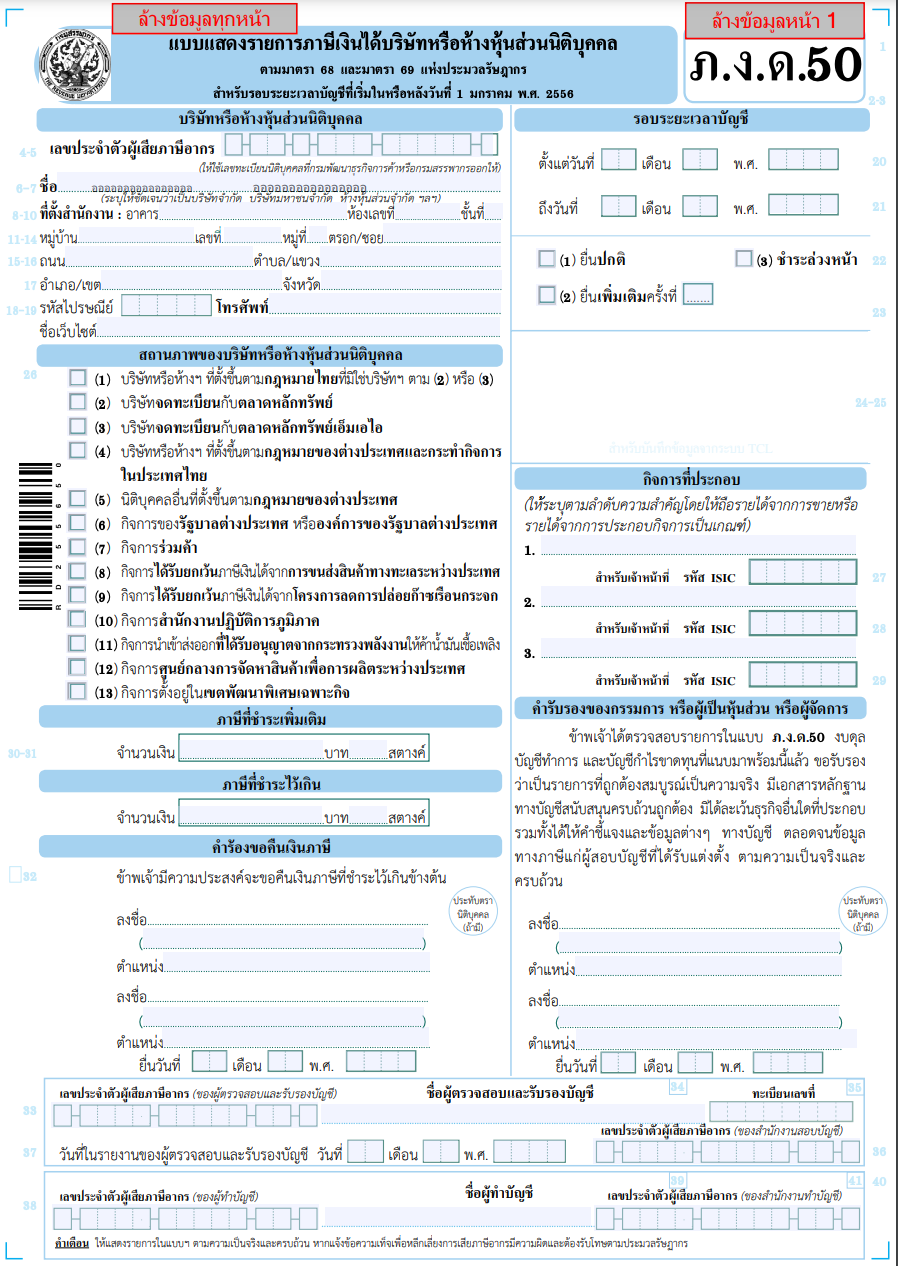
P.N.D.50 is the annual corporate income tax return that companies or partnerships must file to calculate tax on net profits for the entire fiscal year (typically 12 months).
P.N.D.50 reports actual business performance based on audited financial statements. The net profit used for tax calculation must be adjusted according to tax regulations under the Revenue Code.
Entities required to file P.N.D.50 include:
- Limited Companies
- Public Limited Companies
- Limited Partnerships
- Other legal entities as specified by law
What Is P.N.D.51?
P.N.D.51 is the mid-year corporate income tax return, filed to pay tax in advance to ensure the government receives regular income rather than waiting until the fiscal year ends.
There are two methods for filing P.N.D.51, depending on the type of business:
- For general businesses: Calculated as half of the estimated annual net profit.
- For publicly listed companies or financial institutions:
- Calculated from the actual net profit earned in the first six months of the fiscal year.
Entities exempt from filing P.N.D.51 include:
- Newly established corporations with an initial fiscal year of no more than 12 months.
- Foundations or associations.
- Entities granted special fiscal year approval by the Director-General of the Revenue Department.


Differences Between P.N.D.50 and P.N.D.51
● P.N.D.50 is the annual tax return, calculated based on the actual net profit for the full year, as per audited financial statements. It must be filed within 150 days after the fiscal year ends, along with audited financial statements.
● P.N.D.51 is the mid-year tax return, calculated based on estimated annual profit (or actual profit for some businesses), filed within two months after the mid-year period, without requiring audited financial statements.
● The tax paid under P.N.D.51 serves as an advance payment deducted from the final tax payable under P.N.D.50 later.
Filing Deadlines for P.N.D.50 and P.N.D.51
Meeting tax filing deadlines is essential to avoid penalties and surcharges. The filing deadlines are as follows:
Filing Deadline for P.N.D.50
- Paper submission: Within 150 days after the fiscal year-end.
- Online submission: Within 158 days after the fiscal year-end (additional 8 days allowed).
Example: A company with a fiscal year ending December 31, 2022, must file P.N.D.50 by May 30, 2023 (paper filing) or June 7, 2023 (online filing).
Filing Deadline for P.N.D.51
- Paper submission: Within two months after the first half of the fiscal year ends.
- Online submission: Within two months and 8 days after the first half of the fiscal year ends.
Example: A company with a fiscal year from January 1 to December 31, 2022, must file P.N.D.51 by August 31, 2022 (paper filing) or September 8, 2022 (online filing).
What to Do If You Miss the P.N.D.50 or P.N.D.51 Filing Deadline?
Late tax filings result in both criminal and civil penalties, including fines and surcharges:
Penalties for Late P.N.D.50 Filing
- Criminal fine: Late filing within 7 days incurs a fine of 1,000 baht; beyond 7 days incurs a fine of 2,000 baht.
- Surcharge:
- 1.5% per month or fraction thereof on the unpaid tax (capped at 20% of the tax due).
- If filed without receiving a tax notice, surcharge reductions may apply:
- Late by up to 2 days: 0.1% surcharge.
- Late by 2-7 days: 0.5% surcharge.
- Late beyond 7 days: 1.5% per month surcharge applies.
Penalties for Late P.N.D.51 Filing
- Criminal fine: Same as for P.N.D.50.
- Surcharge: Same as for P.N.D.50.
- Additional penalty: If the estimated net profit is under-declared by more than 25% of the actual annual profit without justification, an extra 20% penalty on the shortfall applies.
How to Handle Late Filings?
- File the return as soon as possible and pay any outstanding tax.
- Pay the criminal fine and surcharge as required.
- If there is a reasonable justification, submit an appeal to request a reduction or waiver of the surcharge (criminal fines cannot be waived).
What to Do If the Tax Return Was Filed Incorrectly? (Overpaid/Underpaid)
Tax filing errors are common, often due to miscalculations or misinterpretations of tax laws. Here’s how to correct them:
If Overpaid (Paid More Tax Than Required)
- Submit an amended return:
- For P.N.D.50: File a revised P.N.D.50 with updated financial statements and an explanation letter.
- For P.N.D.51: File a revised P.N.D.51 with an explanation letter.
- Request a tax refund:
- File a refund claim within three years from the filing deadline.
- Attach supporting documents, such as corrected financial statements and tax adjustments.
If Underpaid (Paid Less Tax Than Required)
- Submit an amended return immediately.
- Pay the outstanding tax and surcharge.
- Calculate surcharge:
- 5% per month or fraction thereof on the unpaid tax.
- Ensure P.N.D.51 does not underestimate profit by more than 25%
- Prevent additional penalties:
- Filing an amended return before receiving a tax notice helps avoid further penalties.
- If the error was due to reasonable misinterpretation, an appeal for surcharge reduction can be submitted.


Special Considerations for P.N.D.51
Filing P.N.D.51 carries an additional risk—underestimating annual profit by more than 25%. If no valid reason exists, a 20% penalty on the shortfall applies.
However, the Revenue Department provides exemptions in certain cases:
- Filed at least half of the previous year's tax: If the company has filed P.N.D. 51 in the current year with an amount not less than half of the corporate tax paid under P.N.D. 50 in the previous year.
- Granted a tax exemption or reduced tax rate: If the company has filed P.N.D. 51 in the current year with an amount less than half of the corporate tax paid under P.N.D. 50 in the previous year due to receiving a tax exemption or a reduced tax rate.
Conclusion
Filing corporate income tax returns correctly and on time is crucial for business owners. Understanding the differences between P.N.D.50 and P.N.D.51 and their deadlines ensures compliance.
If filing errors occur, whether late or incorrect, prompt corrections help reduce penalties. Proper tax planning, document preparation, and consulting tax professionals can ensure compliance and prevent future issues.
Related Search Terms
- P.N.D.50
- P.N.D.51
- Incorrect tax filing
- Tax calculation
- Late tax filing