Understand withholding tax in detail—from its meaning, withholding rates, how to file, and how to fix errors or late submissions to the Revenue Department.
Running a business today is not just about selling products or services for profit—you also need to understand related tax obligations. One commonly misunderstood tax is withholding tax. This article helps you understand how it works, your company’s responsib



What is Withholding Tax?
Withholding tax is a pre-collection tax system enforced by the Revenue Department. It requires payers to deduct a portion of the payment before disbursing funds to recipients and then remit the deducted amount to the government. As a result, recipients receive less than the total amount but are provided with a "Withholding Tax Certificate" (commonly known as "50 Twi") as proof of tax payment.
The primary purposes of withholding tax are:
- To ensure a steady revenue flow for the government, rather than waiting until the end of the tax year.
- To ease taxpayers' burden by allowing them to pay taxes in installments rather than a lump sum at year-end.
When Must a Business Deduct Withholding Tax, and at What Rate?
Withholding tax applies when payments meet legal criteria. The deduction rates vary depending on the type of income:
Income Types and Withholding Tax Rates
- Salaries and Wages:
- Tax Rate: Progressive personal income tax rate (0-35%)
- Note: Calculated on annual income after deductions and allowances.
- Contract Work/General Services:
- Tax Rate: 3%
- Example: Website design, business card printing, software development.
- Independent Professions (Lawyers, Engineers, Architects, Accountants, Artists, Doctors):
- Tax Rate: 3%
- Real Estate Rental Payments:
- Tax Rate: 5%
- Note: The lessee must have exclusive access to the property.
- Advertising costs:
- Tax Rate: 2%
- Example: Newspaper, online advertisements.
- Transport charges:
- Tax Rate: 1%
- Note: Excludes Thailand Post, which is exempt.
Conditions for Withholding Tax Deductions
Withholding tax must be deducted when:
- Payments exceed 1,000 baht per transaction.
- If payments are split into multiple transactions but exceed 1,000 baht in total, tax must be withheld on each transaction.
- Monthly service payments under long-term contracts (e.g., phone or internet bills) require withholding even if individual payments are below 1,000 baht, as the annual total exceeds 1,000 baht.
What Happens After Withholding Tax is Deducted?
Once withholding tax is deducted, businesses must fulfill the following obligations:
Issuing a Withholding Tax Certificate (50 Twi)
Businesses must issue a "50 Twi" certificate to recipients, typically in four copies:
- Original Copy: Given to the recipient for tax credit or refund claims.
- Duplicate Copy: Given to the recipient as a record.
- Copy for the Revenue Department: Submitted with the tax return.
- Company Copy: Retained by the business for record-keeping.
A complete 50 Twi certificate should include:
- Name, address, and taxpayer identification number of the payer.
- Name, address, and taxpayer identification number of the payee.
- Type of income paid.
- Amount paid.
- Amount of tax withheld.
- Date of payment and tax deduction.
Remitting Withholding Tax to the Revenue Department
Businesses must remit the withheld tax to the Revenue Department using the appropriate tax return form.
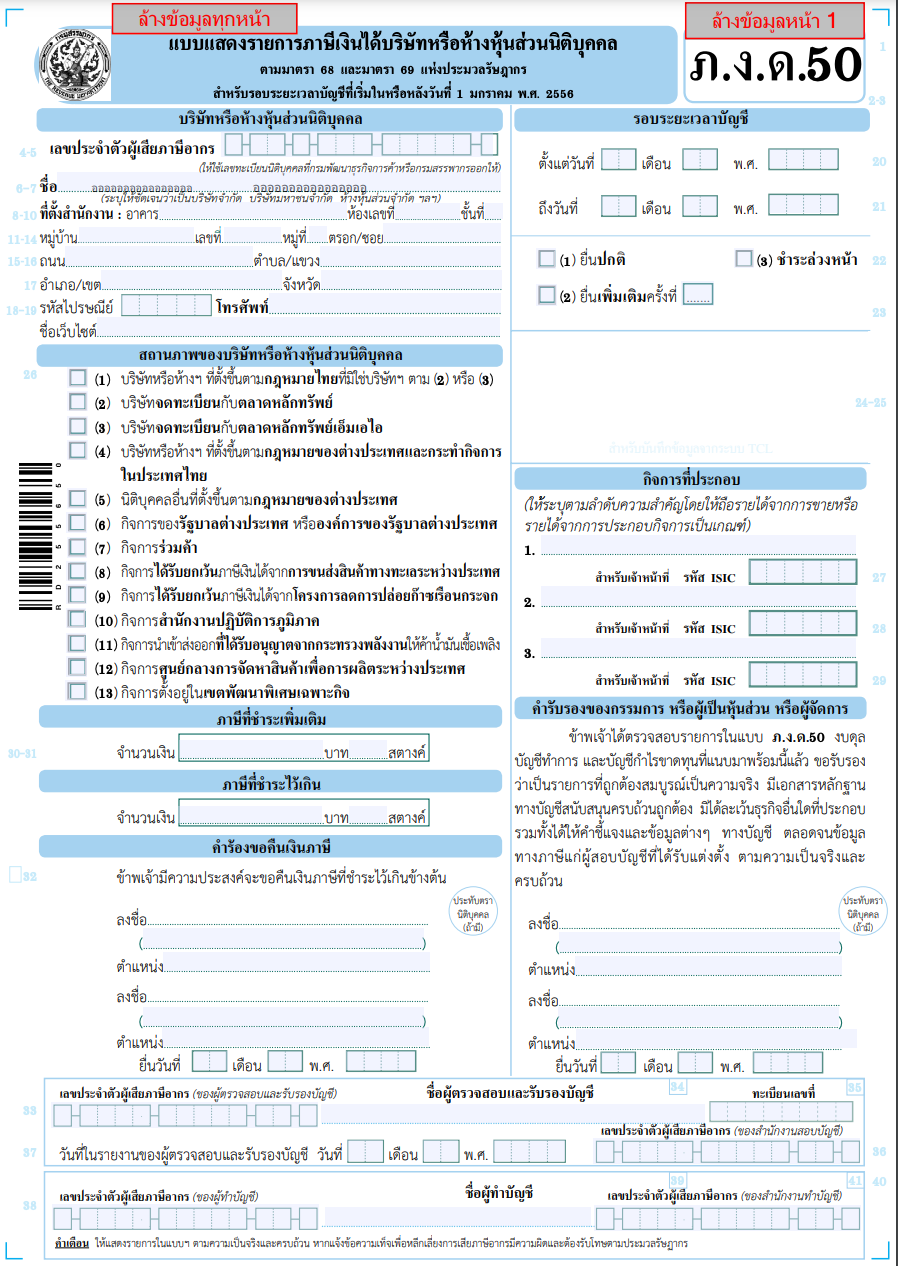
Differences Between P.N.D.1, P.N.D.3, P.N.D.53, and P.N.D.54
Several tax forms exist for remitting withholding tax, depending on the recipient and income type:
1.P.N.D.1
- Used for: Salaries, wages, bonuses, and employee benefits.
- Recipients: Employees (individuals).
- Income Type: Category 1 income (salaries, wages, etc.).
2. P.N.D.2
- Used for: Non-salary payments to individuals.
- Recipients: Non-employees (e.g., freelancers, consultants).
- Income Type: Categories 2-8 (professional fees, rental income, royalties, etc.).
- P.N.D.53
- Used for: Payments to Thai-registered companies or partnerships.
- Recipients: Domestic corporate entities.
- Income Type: Service fees, rental payments, transport fees, advertising costs, interest, dividends, etc.
- P.N.D.54
- Used for: Payments to foreign companies or partnerships not operating in Thailand.
- Recipients: Foreign corporate entities.
- Income Type: All taxable payments to foreign entities.
When Must Withholding Tax Be Submitted?
Tax submission deadlines and methods include:
Filing Deadlines
- Paper Submission: By the 7th of the following month. / Electronic Submission: By the 15th of the following month.
Submission Methods
- Paper Submission: By the 7th of the following month.
- Electronic Submission: By the 15th of the following month.
When Must 50 Twi Be Issued?
- General Cases: Immediately upon tax deduction.
- Employee Salaries: At least once a year, by February 15 of the following year.
- After Tax Submission: Must reference the receipt number and date from the Revenue Department.
What If Withholding Tax Is Not Submitted on Time?
Late submission penalties and remedies:
Penalties for Late Submission
- Surcharge: 1.5% per month or fraction thereof.
- Fine: Up to 100% of the unpaid tax.
How to Rectify Late Submissions
- Submit tax immediately upon realizing the delay.
- File the tax return with a reason for the delay.
- Pay any applicable surcharges.
- If justified, a waiver request for fines (not surcharges) can be submitted.


What If Withholding Tax Is Submitted Incorrectly?
Errors in withholding tax submissions, such as incorrect calculations or using the wrong form, can be corrected as follows:
In Case of Underpaid Tax
- Submit an amended tax return (using the original form but marked as "Amended").
- Report only the missing amount.
- Pay the outstanding tax along with any applicable surcharge.
In Case of Overpaid Tax
- Submit a tax refund request along with supporting documents, such as a copy of the previously filed return and the payment receipt.
- Specify the reason for the refund and the amount requested.
- The Revenue Department will review the request before issuing a refund, which may take between 60 to 180 days.
Wrong Form Used
- File the correct form and indicate the previous incorrect submission.
- Request a refund if necessary.
- Pay additional tax if required.
What If 50 Twi Is Issued Late or Incorrectly?
In Case of Late Issuance of P.N.D. 50 Twi
- Issue the P.N.D. 50 Twi certificate as soon as possible.
- Indicate the actual date of tax withholding and remittance.
- Inform the withholding tax recipient about the delay and the reason.
- There are no direct legal penalties, but delays may impact business relationships.
In Case of an Incorrect P.N.D. 50 Twi
- Cancel the incorrect certificate and issue a corrected one.
- Record a note specifying which certificate was canceled and replaced.
- If the details on the P.N.D. 50 Twi certificate do not match the actual tax remittance, an amended tax return or a tax refund request may be required, depending on the situation.
- Contact the withholding tax recipient promptly to provide the correct certificate, especially before the income tax filing season.
Conclusion
Withholding tax ensures steady government revenue and helps taxpayers avoid large year-end tax payments. Businesses must correctly deduct, issue 50 Twi, and remit the tax within deadlines to avoid fines.
Adhering to tax regulations prevents penalties. For efficiency and accuracy, companies may use accounting software or consult tax professionals.
Related Search Terms
- Revenue Department
- Withholding Tax
- 50 Twi
- Filing P.N.D.1
- P.N.D.3
- P.N.D.53