
How many years can the Revenue Department audit back taxes in Thailand? This guide covers everything you need to know about financial and accounting document reviews, facing a retroactive tax assessment, and the critical details of back tax penalties, helping you prepare and comply with tax laws correctly.
For any business owner, understanding the scope of tax audits by the Thai Revenue Department is fundamental. This includes knowing the time limits for how far back they can investigate, the potential penalties for non-compliance, and the best practices for preparing financial and accounting documents.
Properly maintaining your financial records isn't just good business practice; it's your primary defense against the significant risks and costs associated with a retroactive tax assessment.



The Statute of Limitations for Tax Audits
The period for which the Revenue Department can audit your taxes varies based on the circumstances.
- General Case (No Suspected Evasion): The Revenue Department has the right to assess and collect back taxes for a period of 2 years from the date of the tax filing deadline.
- Case of Tax Evasion: If there is clear evidence of intentional tax evasion, the Revenue Department can extend the audit period to 5 years.
- Case of Failure to File: If a tax return was never filed, the Revenue Department has the authority to initiate legal proceedings for up to 10 years under the Civil and Commercial Code.
Penalties for Incorrect or Late Tax Filings
If you forget to file or file your taxes late, what are the consequences? The penalties and fines for back taxes vary depending on the specific violation. Here is a breakdown for common tax types:
1. Withholding Tax (P.N.D. 1, 2, 3, 53)
- Fine:
- Late filing up to 7 days: ฿100 fine
- Late filing over 7 days: ฿200 fine
- Interest: 1.5% per month on the tax amount due
2. Value Added Tax (VAT) (P.P. 30)
- Case 1: First-Time Late Filing (No previous filing for the period)
- Fine:
- Late filing up to 7 days: ฿300 fine
- Late filing over 7 days: ฿500 fine
- Interest: 1.5% per month on the tax amount due
- Penalty: Calculated at twice the standard rate:
- Paid within 1-15 days: 2% of the tax due (x2)
- Paid within 16-30 days: 5% of the tax due (x2)
- Paid within 31-60 days: 10% of the tax due (x2)
- Paid after 60 days: 20% of the tax due (x2)
- Fine:
- Case 2: Filing an Additional Return (Original return was filed on time)
- Fine: None
- Interest: 1.5% per month on the tax amount due
- Penalty:
- Paid within 1-15 days: 2% of the additional tax due
- Paid within 16-30 days: 5% of the additional tax due
- Paid within 31-60 days: 10% of the additional tax due
- Paid after 60 days: 20% of the additional tax due
3. Mid-Year Corporate Income Tax (P.N.D. 51)
- Fine:
- Late filing up to 7 days: ฿1,000 fine
- Late filing over 7 days: ฿2,000 fine
- Interest / Surcharge: A flat 20% of the tax amount due. However, this may be reduced under specific conditions related to late payment of the tax liability itself.
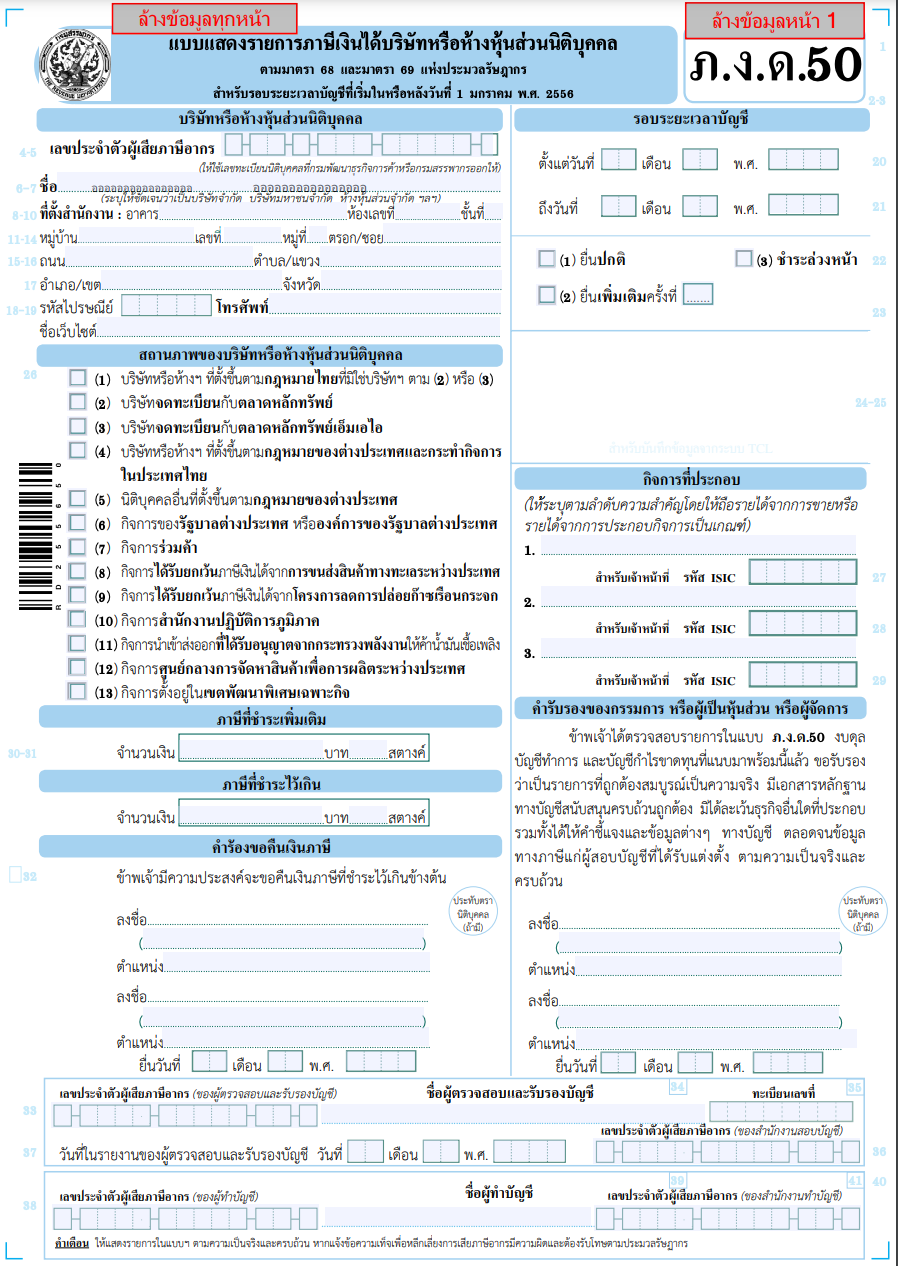
4. Annual Corporate Income Tax (P.N.D. 50)
- Fine:
- Late filing up to 7 days: ฿1,000 fine
- Late filing over 7 days: ฿2,000 fine
- Interest: 1.5% per month on the tax amount due
5. Personal Income Tax (P.N.D. 90/91/94)
- Criminal Fine:
- Late filing up to 7 days: ฿100 fine
- Late filing over 7 days: ฿200 fine
Interest: 1.5% per month on the tax amount due
Understanding the Difference: Penalty, Interest, and Criminal Fine
- Penalty: A fine levied for failing to pay the correct amount of tax, typically calculated as a percentage of the tax shortfall
- Interest: An additional charge, calculated at 1.5% per month on the outstanding tax, designed to incentivize prompt payment
- Fine: A fixed fine imposed for the criminal act of failing to file a return on time, independent of the tax amount owed
Required Documents and Retention Periods
Properly storing accounting and tax documents is crucial for audits by both external auditors and the Revenue Department. It is a legal requirement.
- Accounting Act, B.E. 2543 (Year 2000): This law requires business owners and company directors to retain accounting records and supporting documents for at least 5 years from the closing date of the accounts. This includes:
- Journals (cash, bank, sales, purchases).
- General Ledger accounts (assets, liabilities, income).
- Supporting documents like receipts, invoices, tax invoices, and internal documents (e.g., cash advance forms, travel expense reports).
- Revenue Code, Section 87/3: VAT-registered operators must keep VAT-related documents for at least 5 years from the date of filing or when the report was prepared. This includes:
- Sales tax and purchase tax reports.
- Inventory reports.
- Tax invoices and supporting documentation, organized by month.
Effective Document Management: A Guide to Staying Organized
Overwhelmed by stacks of paperwork? Organizing your documents properly saves time, prevents loss, and ensures you are always prepared.
Advantages of Organized Record-Keeping
- Fast and Easy Retrieval:
Quickly find any document you need, boosting efficiency and reducing frustration. - Prevents Document Loss:
Securely store critical documents like contracts and tax records, minimizing the risk of them being misplaced. - Extends Document Lifespan:
Protect papers from moisture, heat, and pests. - Enhances Confidentiality:
Secure storage of sensitive documents reduces the risk of data leaks.
Professional Techniques for Managing Bulk Documents
Start managing your documents in the following ways:
- Sort Logically:
- Arrange documents alphabetically, chronologically, or by a reference number that makes sense for your workflow.
- Categorize Clearly:
- Create distinct categories, such as "Accounting Documents (e.g., Purchase Invoices)" and "Contractual Documents (e.g., Service Agreements, Employment Contracts)." เอกสารหมวดหมู่บัญชี เช่นใบกำกับภาษีซื้อ เอกสารหมวดหมู่สัญญา เช่น สัญญาจ้างบริการ สัญญาพนักงาน ฯลฯ
- Label Everything:
- Use clear labels on folders, binders, and boxes so you know the contents at a glance.
- Go Digital:
- Scan important documents and store them on a secure computer or cloud service. This creates a vital backup in case the original is lost or damaged.
Systematic document management is key to reducing clutter, preventing damage, and securing your information. Most importantly, it ensures you are always ready for a tax audit.
At METI Accounting, our team of highly experienced experts is ready to provide comprehensive consulting to ensure your compliance to relevant laws. In addition, we offer monthly accounting, auditing services, accounting and tax planning advisory, business and financial seminars, as well as other end-to-end services to support all your business operations.


Related Search Terms
- Back Taxes
- Paying Back Tax Penalties
- Financial and Accounting Documents
- Retroactive Tax Assessment
- Revenue Department Document Audit